

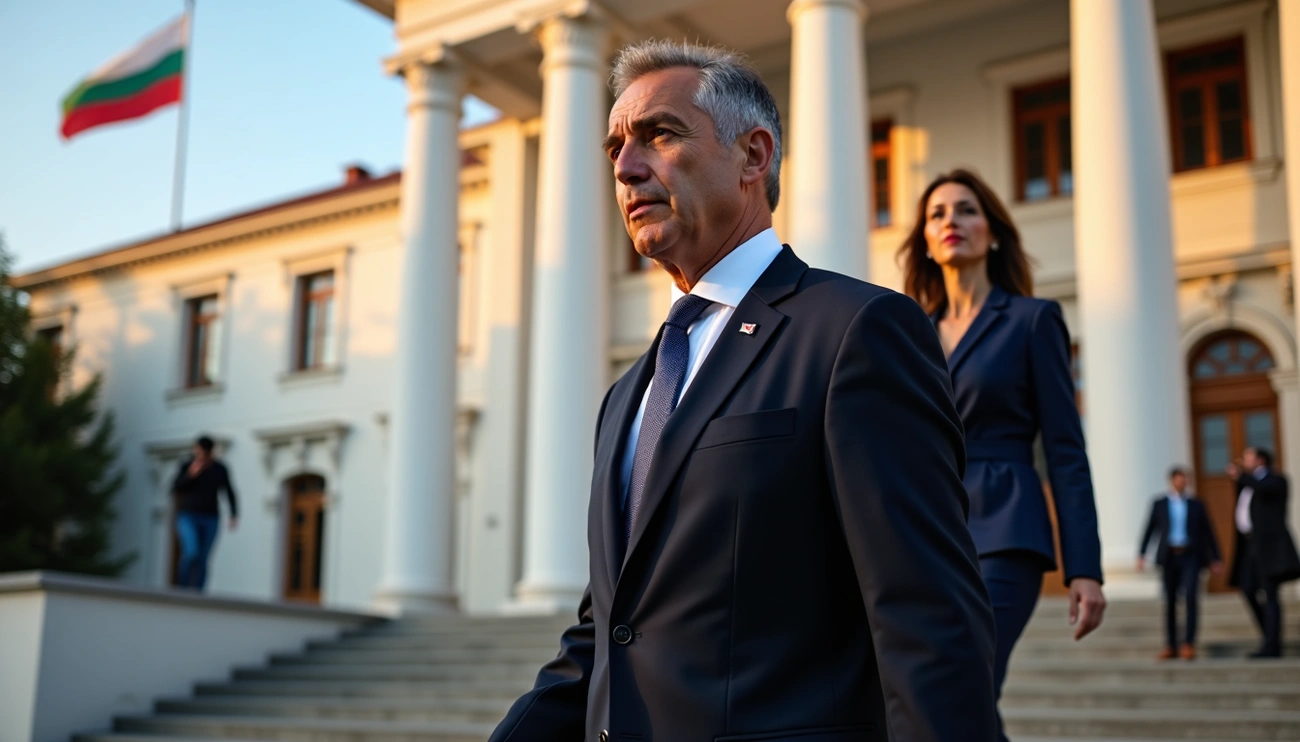
Bulgarian President Rumen Radev shocked the nation with his sudden resignation, marking a historic political moment for the European Union member state. Following his announcement, Radev, 62, transferred his presidential duties to Vice President Iliana Iotova in a brief ceremony, making her the first female president in Bulgaria’s post-communist history. This unexpected development comes as the country struggles with prolonged political instability.
As we examine the implications of President Rumen Radev stepping down before the end of his term, we must understand that his resignation is unprecedented in Bulgarian politics since the fall of communism. The Bulgarian president, a former Air Force general, was initially elected in 2016 and was approaching the conclusion of his second and final mandate. Notably, Bulgaria has experienced significant political turmoil in recent years, holding eight elections in just four years amid ongoing anti-corruption protests since 2020. Rumen Radev, president of Bulgaria, has been a vocal critic of GERB party leader Boyko Borissov and politician Delyan Peevski, who faces sanctions from both the U.S. and U.K.. Many political analysts believe this resignation signals his intention to form a new political party, potentially aimed at fighting corruption in one of the European Union’s poorest countries.
Rumen Radev resigns unexpectedly amid political turmoil

Image Source: Balkan Insight
On January 19, 2026, in a special televised address to the nation, President Rumen Radev announced his unexpected resignation. This historic decision came amid Bulgaria’s prolonged political crisis, with the country headed toward its eighth parliamentary election since 2021. The 62-year-old former Air Force general formally submitted his resignation to the Constitutional Court the following day.
First Bulgarian president to resign before term ends
President Radev’s departure marks the first time in Bulgaria’s post-communist history that a head of state has stepped down before completing their term. His second mandate was scheduled to expire in January 2027, leaving a full year of his presidency unfulfilled. The Constitutional Court unanimously approved his resignation on January 23, with the decision taking immediate effect. In his resignation speech, Radev harshly criticized what he called a “vicious model of governance” and blamed the country’s oligarchy for widespread public disillusionment.
Ceremony hands over power to Iliana Iotova
After the court’s approval, a brief but significant ceremonial event took place at the presidential building. During this solemn occasion, Rumen Radev formally transferred his presidential powers to Vice President Iliana Iotova. The ceremony featured Radev exiting the building and presenting flowers to Iotova before addressing the media. This symbolic handover took place at 4 pm on January 23, with Iotova escorting the departing president to the ceremonial entrance of the presidency building.
Constitutional Court approves resignation
The Constitutional Court’s unanimous decision cleared the way for the vice president to assume full presidential duties. According to Article 97(3) of the Bulgarian Constitution, Iotova will serve as head of state for the remainder of the term until January 2027. Her immediate responsibilities include appointing a caretaker government and setting a date for parliamentary elections, which are expected to take place in late March or early April.
Radev’s resignation comes after the collapse of Prime Minister Rosen Zhelyazkov’s administration in December amid mass protests over corruption and planned tax hikes. Although he has not explicitly confirmed his future plans, many political analysts believe Radev is positioning himself to establish a new political party ahead of the upcoming elections.
Why did Rumen Radev step down early?

Image Source: Al Jazeera
President Radev’s early departure stems from Bulgaria’s unprecedented political deadlock that has plagued the nation for years. The Balkan country has experienced extraordinary electoral volatility, holding seven parliamentary elections in just four years with voter turnout steadily declining from approximately 50.6% in April 2021 to 38.9% by October 2024.
Mounting political instability and failed governments
The political landscape in Bulgaria has become increasingly fragmented, making stable governance nearly impossible. Consequently, a series of weak coalition governments have failed to maintain parliamentary majorities or create lasting alliances. The most recent government crisis erupted in December 2025 when Prime Minister Rosen Zhelyazkov resigned after widespread anti-corruption protests initially sparked by anger over a proposed 2026 budget that would have increased taxes and social security contributions. These demonstrations quickly expanded into broader protests against economic mismanagement and endemic corruption.
Speculation of forming a new political party
While Radev has not explicitly confirmed his political ambitions, considerable evidence suggests he intends to establish his own party. Political analysts have long discussed this possibility throughout Bulgaria’s extended political crisis. In recent public statements, he has hinted at launching a political movement, noting that “people everywhere are demanding it”. A Market Links poll revealed Radev enjoys an approval rating of 44%, making him Bulgaria’s most popular politician according to surveys.
Criticism of current political class and corruption
Throughout his presidency, Radev positioned himself as a staunch opponent of Bulgaria’s entrenched corruption. In his resignation speech, he delivered a scathing assessment of the political establishment, declaring that “today’s political class has betrayed the hopes of Bulgarians” and that “two-thirds of citizens no longer vote”. Moreover, he has consistently criticized former Prime Minister Boyko Borissov and his GERB party, as well as the internationally sanctioned oligarch Delyan Peevski. These targets of his criticism have dominated Bulgarian politics for years, contributing to what Radev termed a “vicious model of governance” that has left Bulgarians disillusioned with their democracy.
Read other Articles – The Secret Philosophy That Made Kevin Roche a Master Architect
What happens after Radev’s resignation?
With Rumen Radev’s departure now official, Bulgaria enters a critical transition period under new leadership. The resignation has triggered constitutional mechanisms designed to ensure governmental continuity despite political upheaval.
Vice President Iotova becomes acting president
Immediately following the Constitutional Court’s approval, Iliana Iotova officially assumed the role of acting president. This historic transition makes her the first woman to serve as Bulgaria’s head of state in the post-communist era. Iotova, formerly a Member of the European Parliament, now holds full presidential powers and responsibilities until January 2027. Her first address to the nation emphasized stability and called for political unity amid ongoing crises.
Caretaker government to be appointed
Among Iotova’s first constitutional duties is the appointment of a caretaker government. This interim administration will manage day-to-day governance and prepare for upcoming elections. Political analysts expect the caretaker cabinet to include technocrats and experienced administrators rather than partisan figures. Their primary mandate will focus on maintaining essential state functions and addressing Bulgaria’s economic challenges.
Snap elections expected in coming months
Furthermore, the resignation necessitates new parliamentary elections. According to constitutional requirements, these must be held within two months of the dissolution of the current parliament. Most political observers expect the elections to take place in late March or early April. This will mark Bulgaria’s eighth parliamentary election in just five years, underscoring the ongoing instability that led to Radev’s resignation. Polling indicates that another fragmented parliament is likely, which could further prolong the country’s governance crisis.
Will Radev launch a new political movement?
Speculation surrounding Rumen Radev’s political future has rapidly transformed into reality. The former president officially announced on January 30 that he will run in Bulgaria’s upcoming parliamentary elections, confirming months of political gossip.
Statements hinting at future political ambitions
Throughout his resignation speech, Radev used language clearly indicating his intentions, declaring a coming “battle for the future of the fatherland” and assertively stating, “We are ready. We can and we will succeed”. In subsequent appearances, he explicitly confirmed entering parliamentary politics, stating, “I have not used the office of president to create a political party. Yet after nine years of traveling across the country and meeting with citizens, it became clear that the political class has failed to meet people’s expectations”.
Public support and approval ratings
Radev enters the political arena from a position of considerable strength. A February 2025 survey by Myara sociological agency found him enjoying the highest approval rating among Bulgarian politicians at 46.7%. A more recent nationwide poll by Market Links revealed 44% of respondents trust him, versus 34% who don’t. Additionally, 64% of Bulgarians approved of his resignation decision, per a Gallup poll for Bulgarian National Television.
Analysts weigh in on potential party formation
Political experts overwhelmingly expect Radev to establish his own party. Nonetheless, most analysts believe he lacks sufficient support to secure an outright majority. Market Links’ managing director estimates Radev would likely receive between 20% and 35% of votes. Particularly significant, political scientist Popivanov describes Radev as “the first politician since 2009 with a real chance” of achieving first place and securing 90-100 MPs.
Impact on GERB and other major parties
Radev’s entrance into electoral politics threatens to fundamentally reshape Bulgaria’s political landscape. His movement would likely consolidate the “nationalist, nostalgic, and Russophile vote”, potentially mobilizing previously apathetic voters. Smaller parties including BSP and There Is Such a People face existential challenges. Furthermore, Radev’s opposition positioning creates possible partnership opportunities with other anti-establishment forces, especially given that the political moment appears uniquely favorable due to widespread exhaustion with the cycle that began in 2020.
Conclusion
Bulgaria stands at a pivotal crossroads following President Rumen Radev’s shocking resignation. Undoubtedly, this unprecedented political maneuver has fundamentally altered the nation’s trajectory after years of escalating instability. The transfer of power to Vice President Iliana Iotova not only marks a historic milestone as she becomes Bulgaria’s first female president in the post-communist era but also signals potential shifts in governance approach during this critical transition period.
After all, Bulgaria has weathered extraordinary political volatility, with eight parliamentary elections in just five years eroding public confidence and participation. Voter turnout has steadily declined from over 50% to under 39%, reflecting widespread disillusionment with a political system many citizens view as corrupt and ineffective. Consequently, Radev’s departure, while surprising in timing, aligns with his consistent criticism of what he termed a “vicious model of governance.”
Meanwhile, all evidence points toward Radev’s imminent entrance into parliamentary politics. His substantial approval ratings—reaching nearly 47% according to some polls—provide him with significant political capital. Nevertheless, challenges remain for any new movement he establishes, as analysts predict he would likely secure between 20% and 35% of votes rather than an outright majority.
The immediate future holds several certainties: a caretaker government will manage day-to-day affairs while preparations begin for yet another parliamentary election, likely in March or April 2026. Beyond these immediate steps, however, lies considerable uncertainty regarding coalition possibilities and governance stability.
Above all, Radev’s resignation and political pivot represent a potential realignment of Bulgaria’s political landscape. His ability to consolidate nationalist and anti-establishment voters while potentially mobilizing previously apathetic citizens could fundamentally reshape parliamentary dynamics. Smaller parties face existential threats while major factions must recalibrate their strategies.
Though Bulgaria continues to grapple with endemic corruption, economic challenges, and political fragmentation, this moment also offers possibilities for meaningful reform. Whether Radev’s bold gambit will break the cycle of instability or simply add another chapter to Bulgaria’s ongoing political crisis remains to be seen. What appears certain, however, is that January 2026 will be remembered as a defining moment in Bulgaria’s democratic journey—one that could either entrench existing patterns or finally chart a path toward more effective governance for this EU member state.
FAQs
Q1. Why did President Rumen Radev resign unexpectedly? President Radev resigned amid mounting political instability in Bulgaria, citing a “vicious model of governance” and widespread corruption. His decision was likely influenced by the country’s prolonged political crisis and his intention to form a new political movement.
Q2. Who is now serving as the acting president of Bulgaria? Vice President Iliana Iotova has assumed the role of acting president following Radev’s resignation. She is the first woman to serve as Bulgaria’s head of state in the post-communist era and will hold this position until January 2027.
Q3. What are the immediate consequences of Radev’s resignation? The resignation triggers the appointment of a caretaker government and necessitates new parliamentary elections, which are expected to be held in late March or early April 2026. This will be Bulgaria’s eighth parliamentary election in just five years.
Q4. How has the public reacted to Radev’s decision to step down? Public opinion polls suggest that Radev enjoys significant support, with approval ratings around 44-47%. A Gallup poll indicated that 64% of Bulgarians approved of his resignation decision, reflecting his popularity among citizens.
Q5. What impact might Radev’s potential new political party have on Bulgarian politics? If Radev forms a new political party as expected, it could significantly reshape Bulgaria’s political landscape. Analysts predict his movement could secure between 20% and 35% of votes, potentially consolidating nationalist and anti-establishment voters and challenging existing major parties.
Interested in similar content or opportunities. Contact Us