

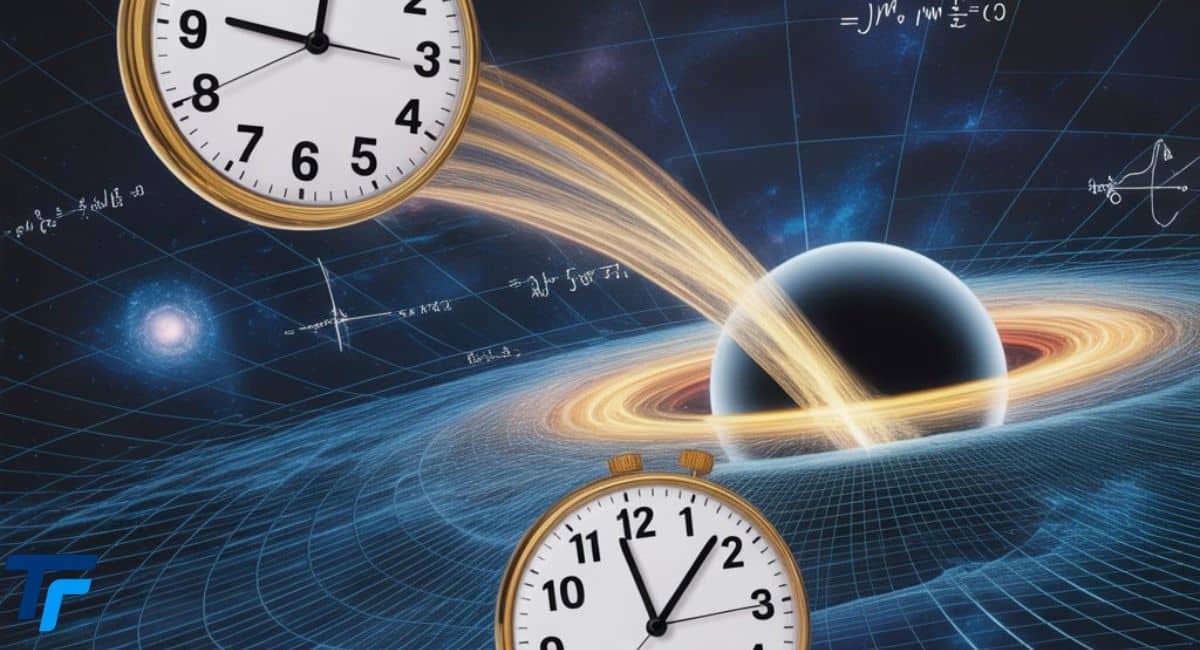
Time feels solid. Dependable. Almost boring.
It’s the one thing we assume we all share, no matter where we are. One second is one second. Yesterday stays behind us. Tomorrow arrives on schedule. You don’t wake up expecting time to wobble.
And yet, it does.
Quietly. Relentlessly. Everywhere gravity exists.
Once you really face the question how does gravity affect time, the universe stops behaving like a tidy machine and starts acting more like a flexible, living system. Time slows. It stretches. It refuses to behave the same way for everyone.
That realization doesn’t just change physics textbooks. It changes how we think about reality itself.
Let’s walk through it—slowly, clearly, and without pretending this isn’t a little weird.
The Comfortable Lie We All Grow Up With
From childhood, we’re taught a simple story: time is universal. Everyone shares the same ticking clock. It’s always moving forward, evenly, like a metronome that never misses a beat.
This idea feels so natural that we rarely question it.
Teachers schedule classes by it. Athletes train around it. Scientists once built entire theories assuming it was true. For centuries, that assumption worked just fine.
But comfort isn’t the same thing as truth.
The moment physicists started measuring the universe with extreme precision, time began acting… uncooperative.
Newton’s Time vs. Einstein’s Time
Isaac Newton imagined time as absolute. In his view, time flowed evenly everywhere, independent of space, motion, or matter. A second on Earth was the same as a second anywhere else in the cosmos.
For a long time, that idea explained almost everything humans could observe. Planets followed predictable paths. Apples fell. Bridges stayed up.
Then Albert Einstein showed up and asked an uncomfortable question:
What if time isn’t separate from space?
That single question unraveled centuries of certainty.
Einstein proposed that space and time are woven together into one structure—space-time. You don’t move through space without moving through time. You don’t experience time without existing somewhere in space.
And gravity? Gravity isn’t a force pulling objects across space. It’s the bending of space-time itself.
Once that idea takes hold, time can no longer be universal.
Gravity: Not a Pull, but a Curve
Here’s the thing most people misunderstand about gravity.
Gravity doesn’t yank objects downward like an invisible rope. It reshapes the environment they move through.
Picture space-time as a flexible surface. Add mass—like a planet or star—and the surface curves. Objects move along those curves, following the geometry laid out by mass.
This explains why planets orbit stars and why light bends near massive objects. But it also explains something far stranger.
Time slows near those curves.
The deeper the curve, the slower time passes.
That’s not poetry. That’s math. And experiments back it up.
So, Really—How Does Gravity Affect Time?
Here’s the plain-language answer:
Stronger gravity makes time run more slowly.
This effect is called gravitational time dilation.
A clock closer to a massive object ticks more slowly than a clock farther away. The clocks don’t break. Nothing “feels” wrong to the person near the mass. But when you compare clocks later, the difference is undeniable.
Time itself has behaved differently.
This isn’t speculation. It’s measurable. Repeatable. Predictable.
Tiny Differences That Refuse to Stay Quiet
On Earth, gravitational differences are modest. Still, they matter.
A clock at sea level runs slightly slower than a clock on a mountain. A clock in a basement runs slower than one upstairs. Even a difference of a few feet changes the rate at which time flows—by an amount too small to notice, but large enough for atomic clocks to detect.
This leads to a delightful, unsettling truth:
Your feet are aging more slowly than your head.
Barely. Almost imperceptibly. But still—yes.
Time is not uniform even within your own body.
Proof Didn’t Come Easily, but It Came Anyway
Einstein’s predictions weren’t immediately testable. Early 20th-century clocks weren’t precise enough to catch such subtle effects.
That changed as technology improved.
Physicists flew atomic clocks on airplanes, then compared them to clocks left on the ground. The airborne clocks disagreed—exactly as predicted. Later experiments placed clocks at different elevations and saw the same effect.
Gravity slowed time.
No philosophical debate survived the data.
The Everyday Miracle You Use Without Thinking
If gravitational time dilation were just a lab curiosity, it would still be fascinating. But it’s more than that.
It’s essential.
Global Positioning System satellites orbit high above Earth, where gravity is weaker. Their clocks tick faster than clocks on the surface—by about 38 microseconds per day.
That might sound insignificant. It isn’t.
Without correcting for this difference, GPS errors would grow rapidly. Your location could be off by kilometers. Navigation apps would become unreliable. Aviation, shipping, and emergency services would suffer.
So engineers correct for gravitational time dilation continuously.
Every time your phone tells you where you are, it’s quietly compensating for Einstein’s universe.
Time, Speed, and a Common Confusion
People often mix up two ideas:
- Speed affects time
- Gravity affects time
Both are true. They’re also connected.
Special relativity shows that motion slows time. General relativity shows that gravity slows time. These aren’t competing effects—they’re different expressions of how space-time behaves.
Motion and gravity both change how you move through space-time.
It’s one framework, not two.
Black Holes: Where Time Stretches to Its Limits
Earth’s gravity is gentle. Black holes are not.
Near a black hole, gravity becomes extreme. Time slows dramatically compared to distant observers. From far away, an object falling toward a black hole appears to slow down, freeze, and fade.
From the falling object’s perspective, time feels normal—at least initially.
This difference in perspective causes endless confusion in movies and casual explanations. Time doesn’t stop. It stretches. Perspective matters.
And once gravity becomes strong enough, our current theories stop working cleanly. That’s not failure—it’s a sign we’ve reached the edge of understanding.
Does Gravity Change How You Age?
Yes.
But not in a way that matters for daily life.
Someone living at sea level ages slightly slower than someone living at high altitude. Over decades, the difference adds up to tiny fractions of a second.
Not enough to brag about. Enough to matter to physics.
Aging follows time. Change time, and you change aging.
That fact alone reshaped how scientists think about life in the universe.
A Small Contradiction That Isn’t One
Here’s something that sounds wrong at first:
You can slow time by moving fast.
You can also slow time by staying still in strong gravity.
How can both be true?
Because time depends on your path through space-time. Speed and gravity both shape that path.
Once you stop thinking of time as independent, the contradiction disappears.
Why This Still Feels So Unsettling
Humans crave shared experiences. Shared moments. A shared “now.”
Gravity destroys that idea.
There is no universal present moment. No master clock ticking for everyone. Each observer carries their own version of time, shaped by motion and mass.
That idea isn’t just scientific—it’s philosophical. It changes how we think about causality, distance, and reality itself.
Moments are local.
That’s hard to accept. But it’s true.
Where Physics Is Still Guessing
Despite everything we know, big questions remain.
What happens to time at quantum scales? How does gravity merge with quantum mechanics? Is time fundamental, or does it emerge from something deeper?
Physicists argue about this constantly. No clean answers yet.
That’s not weakness. That’s curiosity at work.
Living Inside a Flexible Universe
So—how does gravity affect time?
It slows it. Warps it. Shapes it.
Quietly. Constantly. Everywhere.
You don’t notice it when you walk downstairs or climb a hill. But your technology does. The universe does. And once you really understand it, you stop seeing time as a rigid ruler and start seeing it as a responsive fabric.
We aren’t just moving through space.
We’re riding the curves of time itself—second by second, without ever feeling the bend.
And honestly? That’s one of the most astonishing facts science has ever uncovered.
Conclusion: Time Isn’t Broken—It’s Just Honest
So, how does gravity affect time?
It slows it down. Subtly near Earth. Dramatically near massive objects. Predictably everywhere.
What makes this idea powerful isn’t just that it’s strange—it’s that it’s true, measured, and quietly woven into everyday life. Gravity doesn’t just shape planets and stars. It shapes moments. Seconds. Lifetimes.
Time isn’t a rigid ruler snapping forward the same way for everyone. It’s more like a responsive fabric, stretching and tightening depending on mass and motion. We live inside that fabric, whether we notice it or not.
And maybe that’s the most human part of this story. The universe isn’t cold or mechanical in the way we once imagined. It’s dynamic. Relational. Sensitive to where you are and how you move.
You don’t need to feel gravity slowing your time for it to matter. It already does. Every second, every step, every signal from a satellite above your head is proof.
Time hasn’t betrayed us.
We just finally learned how flexible it’s always been.
FAQ: Gravity, Time, and the Questions Everyone Asks
Does gravity really slow down time, or is that just theory?
It really does. This isn’t speculation or philosophy. Gravitational time dilation has been measured repeatedly using atomic clocks, satellites, airplanes, and elevation differences on Earth. The results match Einstein’s predictions with remarkable accuracy.
Why don’t we notice time slowing down in everyday life?
Because the effect is extremely small under normal conditions. Earth’s gravity isn’t strong enough to create noticeable differences for human senses. You need ultra-precise clocks to detect it. Still, “small” doesn’t mean “zero,” and physics cares deeply about that distinction.
Is time slower at sea level than on a mountain?
Yes. Gravity is slightly stronger at sea level because you’re closer to Earth’s center. As a result, time passes a tiny bit more slowly there compared to higher elevations. The difference is microscopic, but it’s real and measurable.
Does this mean my head ages faster than my feet?
Technically, yes. Your head is farther from Earth’s center than your feet, so it experiences slightly weaker gravity. That means time runs just a bit faster at your head. The difference is unbelievably small, but physics doesn’t ignore small truths.
How does this affect GPS and technology?
GPS satellites experience weaker gravity than objects on Earth, so their clocks tick faster. Engineers must correct for this effect constantly. Without accounting for gravitational time dilation, GPS systems would become inaccurate very quickly.
Is gravitational time dilation the same as time slowing due to speed?
They’re related but not identical. Speed slows time due to special relativity, while gravity slows time due to general relativity. Both arise from how space-time works. They aren’t competing ideas—they’re parts of the same framework.
What happens to time near a black hole?
Near a black hole, gravity becomes extremely strong, causing time to slow dramatically compared to distant observers. From far away, it looks like objects freeze near the edge. From the object’s own perspective, time continues normally—at least until physics reaches limits we don’t fully understand yet.
Can gravity ever stop time completely?
According to current physics, time doesn’t fully stop. It can slow down enormously relative to other observers, but complete stoppage is more of a theoretical edge case than a practical reality. Our understanding breaks down before we reach a final answer.
Does gravity affect time everywhere in the universe?
Yes. Wherever there is mass, gravity exists, and wherever gravity exists, time is affected. The strength of the effect depends on how much mass is present and how close you are to it.
Why does this matter beyond science?
Because it changes how we understand reality. Time isn’t universal or absolute. Moments aren’t shared the same way across the universe. That reshapes not just physics, but how we think about cause, experience, and existence itself.
Disclaimer
This article is intended for educational and informational purposes only. It presents scientific concepts related to gravity, time, and relativity in simplified language designed for general understanding, not as a substitute for formal academic instruction or professional scientific consultation.
While every effort has been made to ensure accuracy and alignment with established physics—particularly Einstein’s theory of general relativity—some explanations use analogies, metaphors, and conversational phrasing to improve clarity and readability. These simplifications may omit mathematical rigor or edge-case nuances present in advanced research.
This content should not be used as a sole source for academic work, technical engineering decisions, or professional scientific analysis. For formal study, readers are encouraged to consult peer-reviewed journals, university textbooks, or authoritative resources such as publications from NASA, CERN, or leading physics institutions.
Science is an evolving field. Interpretations, models, and open questions discussed here reflect current mainstream understanding and may change as new evidence emerges.
In short: this article aims to inform, inspire curiosity, and explain, not to replace formal education or expert guidance.
If you liked this post Visit Other Posts Click Here.