

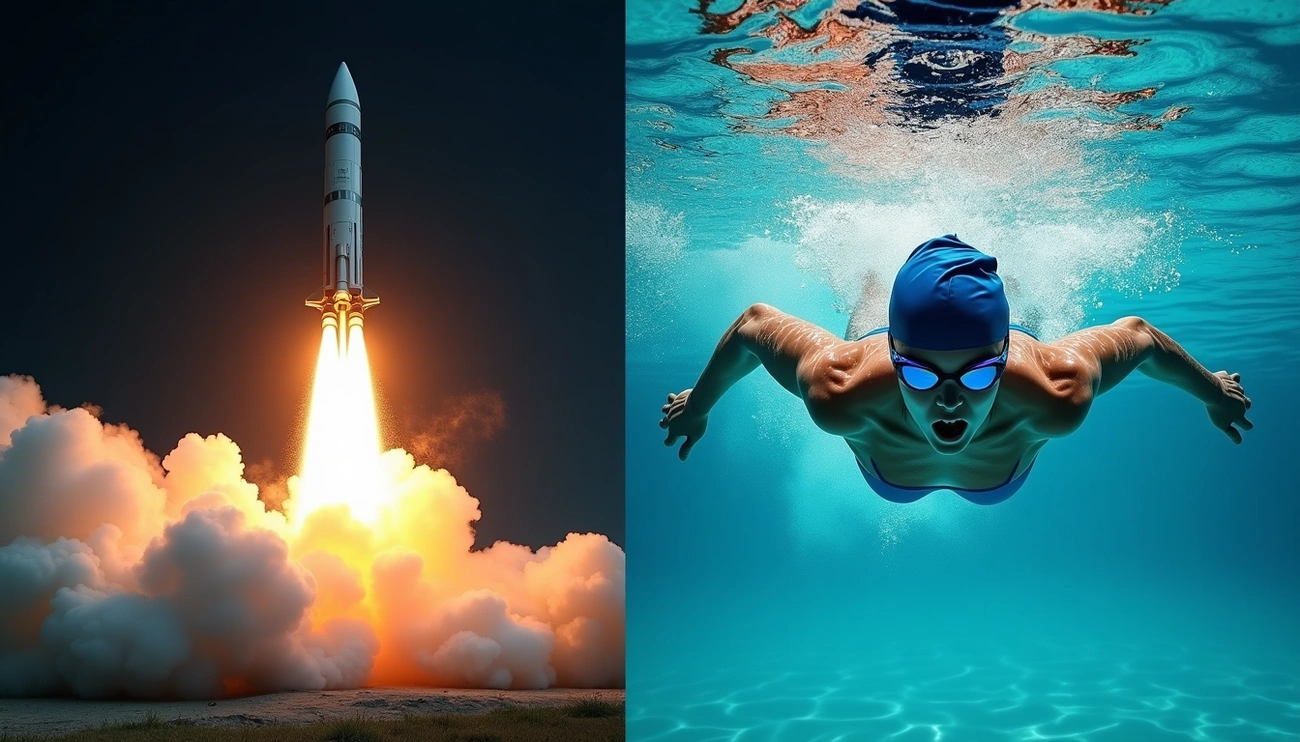
Newton’s 3rd law governs every push and pull we experience in our daily lives. When we walk, swim, or even sit in a chair, we’re actually witnessing this fundamental principle in action: for every action, there is an equal and opposite reaction. This powerful concept explains everything from how fish swim through water to how massive rockets launch into space, generating approximately 2,000 pounds of thrust.
What is Newton’s third law of motion? Formulated by Isaac Newton in 1687, it states that forces always exist in equal and opposite pairs. When one object exerts a force on another, it experiences an equal magnitude force in the opposite direction. For instance, when a fish uses its fins to push water backward, the water simultaneously pushes the fish forward with exactly the same force. Throughout this article, we’ll explore newton’s 3rd law definition, examine numerous examples of Newton’s third law in everyday situations, and clear up common misconceptions about this fundamental principle of physics. We’ll also discover how understanding force pairs can help us make sense of the physical world around us.
Read other Articles – What Are The Types of Marpesthtic?
What is Newton’s Third Law?
Sir Isaac Newton formulated his third law of motion in 1687 as part of his groundbreaking work “Philosophiæ Naturalis Principia Mathematica.” This principle remains one of the fundamental concepts that explains how forces operate in our universe.
Definition of Newton’s 3rd law of motion
Newton’s third law states that “for every action, there is an equal and opposite reaction.” More precisely, whenever one object exerts a force on a second object, the second object exerts an equal force in the opposite direction on the first object. These forces act on different bodies but are equal in magnitude and opposite in direction.
The mathematical expression is straightforward: F₁₂ = -F₂₁, where F₁₂ is the force exerted by object 1 on object 2, and F₂₁ is the force exerted by object 2 on object 1. The negative sign indicates the forces point in opposite directions.
Understanding action and reaction forces
Action and reaction forces are two sides of the same interaction. Importantly, these forces:
- Always occur simultaneously
- Are equal in magnitude
- Act in opposite directions
- Act on different objects
Consider pressing your hand against a wall. As you push on the wall (action force), the wall pushes back on your hand (reaction force) with exactly the same strength. This explains why the wall doesn’t move—the reaction force isn’t acting on the wall but rather on your hand.
Why forces always come in pairs
Forces inherently exist in pairs because they represent interactions between objects. Furthermore, this pairing occurs due to the fundamental nature of force as described by Newton—it’s impossible to have a single, isolated force in nature.
The existence of force pairs explains numerous phenomena. For example, a hammer striking a nail transfers force to the nail, but consequently, the nail exerts an equal force back on the hammer, stopping its motion. This interaction creates the characteristic “bounce” we feel when hammering.
Indeed, understanding that forces never exist in isolation helps us make sense of countless physical interactions, from rocket propulsion to the simple act of walking. Essentially, Newton’s third law reminds us that no object is ever truly passive in a physical interaction—each participant actively responds with its own force.
Everyday Examples of Newton’s Third Law

Image Source: Science Notes and Projects
Looking around us, Newton’s third law of motion manifests in countless everyday situations. From the mundane to the extraordinary, these action-reaction pairs shape how we move through the world.
Fish swimming in water
Fish propel themselves forward by pushing water backward with their fins and tail. As they sweep their tail to the left, they push water in that direction. The water, following Newton’s 3rd law, pushes back on the fish with equal force in the opposite direction, propelling the fish rightward. This continuous tail movement creates the characteristic swimming motion we observe.
Birds flying by pushing air
Similarly, birds achieve flight through this same principle. When a bird flaps its wings downward, it exerts a force on the air, pushing it down. Correspondingly, the air pushes upward on the bird’s wings with equal force. This upward reaction force is what counters gravity and enables flight. During forward movement, birds also push air backward, creating the reaction force that propels them forward.
Car tires pushing against the road
When driving, your car’s engine causes the tires to push backward against the road surface. In response, the road pushes forward on the tires with equal magnitude. This forward reaction force is what moves your vehicle ahead. Moreover, this explains why cars struggle on ice—without sufficient friction, tires can’t effectively push against the surface.
Rocket propulsion in space
Perhaps the most dramatic example of Newton’s third law occurs in space travel. A rocket expels high-speed gasses downward through its engines. Subsequently, these gasses push back on the rocket with equal force, thrusting it upward. Notably, this principle works even in the vacuum of space, disproving the misconception that rockets need air to push against.
Jumping off a boat onto a dock
When you jump from a boat to a dock, you push backward on the boat. The boat, in turn, pushes you forward with equal force. This reaction often causes the boat to drift away from the dock—a practical demonstration of action and reaction forces that many have experienced firsthand.
These everyday applications illustrate how Newton’s third law fundamentally governs motion throughout our universe, from microscopic interactions to cosmic phenomena.
Common Misconceptions and Clarifications
Despite extensive study of Newton’s third law of motion, misconceptions persist, with studies showing that 83.64% of common misunderstandings can be minimized through proper instruction.
Do action and reaction forces cancel each other?
A fundamental misconception about newton’s 3rd law involves believing that action and reaction forces cancel each other out. Nevertheless, these forces never cancel each other since they act on different objects. Consider pushing a wall—you exert a force on the wall while it simultaneously pushes back on you with equal force. These forces don’t cancel because one acts on the wall and the other on you.
Why heavier objects don’t always move
Whether an object moves depends on the net force acting upon it, not just newton’s third law pair. For instance, if a horse pulls a carriage, the carriage pulls back equally on the horse. Still, if the horse’s forward force from ground friction exceeds this backward pull, the system moves forward.
The role of mass in acceleration
Although action-reaction forces are equal in magnitude, the resulting accelerations differ based on mass. Hence, if a firefly hits a bus windshield, both experience equal forces, yet the firefly suffers greater consequences given its smaller mass.
Why Newton’s third law applies even in space
Unlike popular belief, rockets work better in vacuum environments. Additionally, astronauts experience this law dramatically—even typing on a keyboard can send them floating away unless anchored.
Read other Articles – What Is DGH (Directorate General of Hydrocarbons)?
Using Newton’s Third Law in Problem Solving

Image Source: TEKS Guide
Applying Newton’s third law in physics problems requires systematic analysis and clear understanding of force interactions. Mastering these problem-solving techniques helps unravel complex mechanical situations through the lens of action-reaction pairs.
Identifying force pairs in diagrams
Force diagrams become significantly clearer once you recognize newton’s 3rd law pairs. To identify these pairs effectively:
- Look for interacting objects
- Draw arrows showing the forces between them
- Label each force with both the object experiencing it and the object causing it
Remember that force pairs act on different objects. In a properly labeled diagram, you’ll notice forces like F_earth on book and F_book on earth—representing what is newton’s third law in visual form.
How to apply the law in physics problems
Specifically in problem-solving, newton’s third law of motion serves as a powerful analytical tool. First, identify all interacting objects in the system. Then, methodically list each action-reaction pair before writing equations.
The classic mistake occurs when confusing newton’s 3rd law pairs with balanced forces on a single object. According to physics instructors, these concepts require distinct approaches in calculations.
Examples of Newton’s 3rd law in calculations
Consider a 70kg astronaut pushing off a 500kg satellite with 100N force. Using newton’s 3rd law definition, we know the satellite pushes back with exactly 100N. However, the resulting accelerations differ dramatically.
For the satellite: a = F/m = 100N/500kg = 0.2 m/s² For the astronaut: a = F/m = 100N/70kg = 1.43 m/s²
This simple calculation demonstrates examples of newton’s third law in action—equal forces producing unequal accelerations due to mass differences. Such applications reveal why understanding force pairs transforms ordinary physics problems into logical, step-by-step analyzes.
Conclusion
Newton’s Third Law remains one of the most profound principles governing our physical universe. Throughout this exploration, we’ve seen how this fundamental concept explains a wide range of phenomena. Force pairs influence everything from our daily movements to space exploration, showing that nature maintains balance through equal and opposite interactions.
The practical applications of this law go far beyond textbook examples. Fish propelling through water, birds soaring through air, cars accelerating on roads, and rockets launching into space all rely on this principle. Even simple activities like walking or jumping illustrate how we unconsciously depend on action-reaction forces every day.
Common misconceptions about force pairs often lead to confusion. However, we now understand that these forces never cancel each other because they act on different objects. The resulting motion depends not only on these paired forces but on the entire force system acting on each body. Differences in mass explain why identical forces produce drastically different accelerations between interacting objects.
Physics problem-solving becomes significantly simpler when we correctly identify and analyze force pairs. This systematic approach transforms complex mechanical situations into manageable calculations, allowing us to predict motion outcomes accurately.
Thus, Newton’s Third Law is more than just a scientific principle—it provides a framework for understanding the physical world. The next time you push against something, remember that it pushes back with the same force. This reciprocal nature of forces explains not only how we move through our environment but also how the universe maintains its delicate balance of motion and interaction.
FAQs
Q1. How does Newton’s Third Law apply in everyday life? Newton’s Third Law is evident in many daily activities. When you walk, you push backward on the ground, and the ground pushes you forward. When you swim, you push water backward, and it propels you forward. Even sitting in a chair demonstrates this law, as you exert a downward force on the chair, and it pushes back with an equal force to support you.
Q2. Can you explain Newton’s Third Law in simple terms? Newton’s Third Law states that for every action, there is an equal and opposite reaction. This means that when one object exerts a force on another object, the second object exerts the same force back on the first object. For example, when you jump off a boat onto a dock, you push backward on the boat, causing it to move away from the dock.
Q3. Why don’t action and reaction forces cancel each other out? Action and reaction forces don’t cancel each other out because they act on different objects. For instance, when you push a wall, you exert a force on the wall, and the wall exerts an equal force back on you. These forces don’t cancel because one acts on the wall and the other on you. The resulting motion depends on the entire force system acting on each body.
Q4. How does Newton’s Third Law work in space? Newton’s Third Law applies equally in space as it does on Earth. In fact, it’s more noticeable in space due to the absence of other forces like friction. When an astronaut pushes off a spacecraft, they move in one direction while the spacecraft moves slightly in the opposite direction. This principle is also what allows rockets to propel themselves through the vacuum of space.
Q5. How is Newton’s Third Law used in problem-solving? In physics problem-solving, Newton’s Third Law is a powerful analytical tool. It helps in identifying force pairs between interacting objects. When drawing force diagrams, each force should be labeled with both the object experiencing it and the object causing it. This systematic approach transforms complex mechanical situations into manageable calculations, allowing accurate predictions of motion outcomes.
Interested in similar content or opportunities. Contact Us