

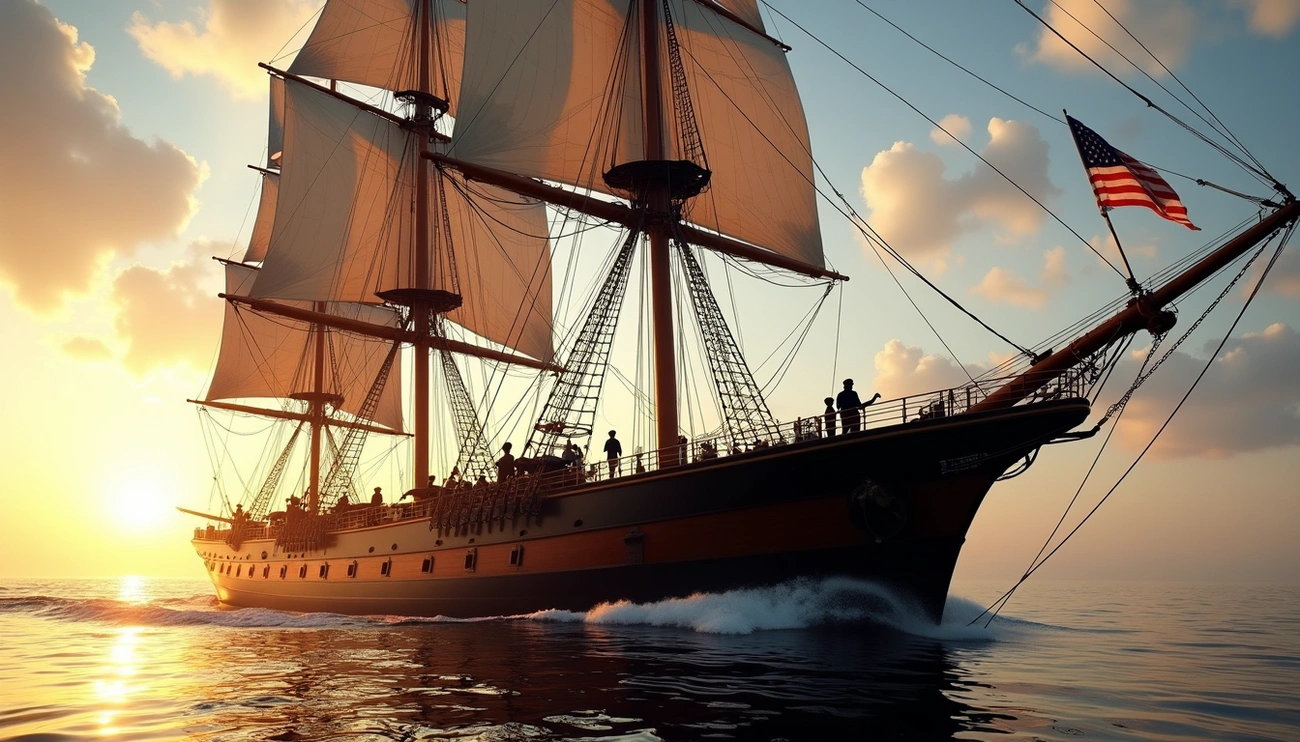
USS Severn stands as a remarkable example of 19th-century American naval engineering. Originally laid down as Mosholu in October 1864 at the New York Navy Yard, this impressive wooden screw sloop-of-war stretched 296 feet 10 inches in length with a displacement of 3,003 tons.
Commissioned on August 27, 1869, under Commander Reigart B. Lowry, the USS Severn quickly became a key player in American naval operations. Serving as the flagship of the North Atlantic Squadron under Rear Admiral Charles H. Poor, the vessel was involved in several significant missions. Despite being active for just over two years before its decommissioning on December 31, 1871, the USS Severn crew notably participated in investigating the alleged mistreatment of a United States consul at Santiago de Cuba in April 1871.
In this article, we will delve into the intriguing history of this Contoocook-class frigate, from its construction during the Civil War era to its brief but impactful service. We will also examine its technical specifications, including its armament of 14 Dahlgren guns and a 60-pound Parrott rifle, and trace its journey from active service to its eventual sale on March 2, 1877.
Read other Articles – What Is DGH (Directorate General of Hydrocarbons)?
Civil War Origins and Strategic Purpose

Image Source: Wikipedia
Civil War Origins and Strategic Purpose
Union fears of British intervention and commerce raiding
The origins of the USS Severn can be traced directly to the strained relationship between the United States and Great Britain during the American Civil War. Despite claiming neutrality, British shipyards in Liverpool built numerous vessels for Confederate use, exploiting legal loopholes by ensuring the ships weren’t armed until they reached neutral waters. These British-built privateers wreaked havoc on Union shipping routes, with the CSS Alabama alone destroying 65 merchant vessels.
This maritime disruption had a severe impact on the American economy, driving up domestic prices and forcing the Union Navy to reassign ships from blockade duties. Additionally, Union officials were deeply concerned that Britain might eventually intervene to support the Confederacy, a scenario in which the Union Navy would be significantly outmatched by the Royal Navy.
Authorization of Contoocook-class sloops in 1863
In response to these threats, the Union developed a strategic countermeasure. Rather than attempting to match the Royal Navy in conventional battles, American planners adopted a similar commerce raiding approach that had been so effective against their own shipping. Congress consequently authorized 27 “commerce destroyers” in 1863, vessels specifically designed with the range and speed necessary to intercept enemy ships at sea. These ships were divided into three classes:
- Wampanoag-class frigates: Largest and fastest
- Java-class frigates: Most heavily armed
- Contoocook-class sloops: Smallest design
This naval buildup represented a significant shift toward a post-war doctrine focused on protecting American interests rather than competing directly with European naval powers.
USS Severn’s original name: Mosholu and its meaning
The vessel that would eventually become USS Severn was initially named Mosholu after a town in New York. Of the ten planned Contoocook-class vessels, only four ships—Albany (ex-Contoocook), Congress, Severn, and Worcester—were ultimately completed between 1868 and 1869. The renaming occurred because Secretary of the Navy Adolph Borie disapproved of warships bearing Native American-sounding names, considering the naming conventions across the fleet unclear and inconsistent. Consequently, he ordered a systematic renaming of vessels to create more uniformity in the fleet’s nomenclature.
Design Features of the Contoocook-Class Sloop
Designed by John Lenthall, the Contoocook-class vessels represented cutting-edge naval engineering of the post-Civil War era. These sloops featured distinctive “clipper” styling with streamlined hulls optimized for both speed and endurance—qualities essential for commerce protection and potential raiding operations.
Hull dimensions and displacement: 296 ft, 3,003 tons
The USS Severn’s hull exhibited the characteristic long, narrow, and shallow design of the Contoocook-class. Measuring 296 feet 10 inches along the gun deck with a 41-foot beam and depth of 13 feet 3 inches, this wooden vessel displaced 3,003 short tons (2,681 long tons). Unlike many contemporary vessels, the Contoocook-class hulls prioritized velocity over armor protection, reflecting their intended strategic role for rapid transoceanic voyages. The ship typically carried a crew complement of 250 officers and sailors, somewhat smaller than the standard 350 personnel aboard other Contoocook-class vessels.
Steam and sail propulsion system: 13-knot top speed
Owing to engineering advancements of the era, USS Severn employed a hybrid propulsion system combining traditional sails with steam power. The vessel housed four main boilers plus two superheating boilers that supplied steam to two horizontal back-action engines with 36-inch stroke. This machinery turned a single propeller while the ship-rigged sail plan provided auxiliary power. Under ideal conditions, this dual-power configuration allowed USS Severn to achieve approximately 13 knots, although speeds up to 14 knots were possible in perfect circumstances with both steam and sails working together.
Armament layout: 8 Dahlgren guns and 1 Parrott rifle
Throughout her brief service life, USS Severn carried a formidable arsenal typical of post-Civil War naval vessels. Her primary armament consisted of eight 9-inch Dahlgren smoothbore guns arranged in broadside configuration along the gun deck. This main battery was supplemented by a single 60-pound Parrott rifled muzzle-loading gun positioned on the foredeck for forward fire support. While some sources indicate the vessel could mount up to fourteen Dahlgren cannons, the most reliable documentation confirms the eight-gun configuration plus the Parrott rifle as her standard complement.
USS Severn’s Short-Lived Naval Service
Flagship role in the North Atlantic Squadron (1869–1871)
After commissioning on August 27, 1869, USS Severn immediately received an important assignment as the flagship for the North Atlantic Squadron. Under Rear Admiral Charles H. Poor, the vessel served in this prestigious capacity from 1869 to 1871. Throughout this period, the ship provided a commanding presence along America’s eastern seaboard, conducting routine patrols and representing naval interests at various ports.
Investigation mission to Santiago de Cuba in 1871
Perhaps the most significant operational deployment occurred in April 1871, when USS Severn sailed to Santiago de Cuba. This mission involved investigating alleged mistreatment of a United States consul stationed there. The diplomatic nature of this assignment highlighted the vessel’s role beyond mere military operations—indeed, naval ships often served as instruments of foreign policy through such “gunboat diplomacy” missions.
USS Severn crew list and command under Reigart B. Lowry
Commander Reigart B. Lowry led USS Severn throughout her brief service life. The ship typically maintained a complement of approximately 250 officers and enlisted personnel—somewhat smaller than the standard 350-man crews aboard other vessels of the Contoocook class. Following the Santiago mission, USS Severn returned to normal duties until December 31, 1871, when officials decommissioned the ship at the Washington Navy Yard after merely 28 months of active service.
Read other Articles – A Closer Look at Newton’s Third Law
Decommissioning, Sale, and Final Fate
The structural deficiencies plaguing USS Severn emerged primarily from rushed wartime construction practices.
Structural issues from green timber construction
Wartime urgency forced shipbuilders to use heterogeneous green timber throughout the Contoocook class, creating serious long-term problems. This undried wood subsequently shrank, rotted, and left USS Severn requiring extensive uneconomic repairs. After arriving at Boston on December 31, 1871, USS Severn entered decommissioned status for necessary repairs. Once completed by 1875, officials never recommissioned her for active service.
Transfer to New London and sale to John Roach in 1877
In 1875, naval authorities transferred the dormant vessel to New London, Connecticut. USS Severn remained there until returning to New York in 1877. On March 2, 1877, the Navy sold USS Severn to prominent shipbuilder John Roach. This transaction, however, involved more than a simple ship sale.
Scrapping to fund the new USS Puritan without Congress
The sale represented part of a complex arrangement to finance work on the ironclad USS Puritan without Congressional oversight. Essentially, USS Severn partially compensated Roach for repairs made to Puritan. The Navy had allowed the original Puritan to deteriorate, yet Congress authorized only repair funds, not a new ship. As a result, Roach broke up the former flagship, with proceeds joining congressional allocations to fund an entirely new Puritan.
Conclusion
Thus, USS Severn stands as a fascinating chapter in American maritime history, albeit a brief one. Despite serving merely 28 months, this wooden screw sloop-of-war fulfilled significant naval duties as the North Atlantic Squadron flagship. Built during a pivotal period when the Union Navy needed commerce protection vessels, USS Severn exemplified the strategic naval thinking that emerged from Civil War experiences.
Additionally, the vessel’s technological features showcased the transitional naval architecture of the late 1860s, combining traditional wooden hull construction with advanced steam propulsion. The hybrid sail-steam configuration, impressive 13-knot speed capability, and formidable armament certainly reflected the naval engineering advancements of the era.
Nevertheless, the ship’s premature retirement underscores the construction challenges faced during wartime production. The use of green timber ultimately doomed not only USS Severn but several sister vessels to structural deterioration. Consequently, what began as an ambitious naval program ended with the vessel being sold and dismantled.
Perhaps most interestingly, USS Severn’s final contribution came through its sale to John Roach, essentially helping fund the new USS Puritan through a creative financing arrangement that circumvented congressional limitations. Therefore, while Severn’s active service proved short-lived, its story provides valuable insights into post-Civil War naval policy, shipbuilding practices, and the administrative ingenuity sometimes employed within the Department of the Navy during the Reconstruction era.
FAQs
Q1. What was the primary purpose of the USS Severn? The USS Severn was designed as a “commerce destroyer” to protect American shipping interests and potentially conduct commerce raiding operations against enemy vessels during times of conflict.
Q2. How long did the USS Severn serve in active duty? The USS Severn had a relatively short active service life of only 28 months, from its commissioning on August 27, 1869, to its decommissioning on December 31, 1871.
Q3. What unique features did the USS Severn possess? The USS Severn featured a hybrid propulsion system combining traditional sails with steam power, allowing it to achieve speeds of up to 13 knots. It also carried a formidable arsenal of eight 9-inch Dahlgren guns and one 60-pound Parrott rifle.
Q4. Why was the USS Severn decommissioned so quickly? The USS Severn suffered from structural issues due to the use of green timber in its construction, which led to shrinkage and rot. These problems made extensive repairs uneconomical, leading to its early decommissioning.
Q5. What happened to the USS Severn after it was decommissioned? After decommissioning, the USS Severn was sold to shipbuilder John Roach in 1877. It was then broken up as part of a complex arrangement to fund the construction of a new ironclad, the USS Puritan, without direct Congressional oversight.
Interested in similar content or opportunities. Contact Us